Skip to Content
  • Articles
  • Resources
  • Content & Campaigns
  • Strategy & Planning
  • Training & Capacity
  • Building Power for Immigrant Justice with Data-informed Audience Selection

    Dec 9, 2025

    Issues
    A woman looks at an influencer video on her phone.

    As the Trump regime’s immigration crackdown accelerates, cruelty and chaos are hitting home in cities and towns across the country. First it was Los Angeles, then Portland, then Chicago, and now Charlotte. Communities across the nation are reeling from the attacks, and at the very same time, fighting back and welcoming new people to the vibrant, powerful migrant justice movement.

    Clearly, we are in a moment where threat and opportunity are accelerating simultaneously. Within the intensity of the crackdown, we see a powerful opportunity to build solidarity, expand the reach of our organizations and campaigns, and activate the many people new to social movements who are now ready to act.

    The TL;DR? Catalyze new supporters by 1) Reaching beyond the “progressive base,” 2) Pulling folks up your ladder of engagement, 3) Building bridges from online to offline organizing, 4) Matching your values to your audiences, and 5) Integrating your audience learnings into your work with influencers.

    Leveraging this opportunity depends on data-driven digital audience outreach, a solid ladder of engagement, and smart coordination with both digital and IRL organizers. Our movements need to be able to identify and then reach current and future supporters. Here we share 5 key learnings from our work using our powerful new database to garner immigration justice digital engagement.

    Reach beyond the base

    We can and should reach beyond the progressive base. Moderates across party and racial and geographic lines are increasingly concerned and angered by the regime’s focus on targeting long-standing and essential immigrant members of our communities, invading cities, and siphoning public dollars into the pockets of billionaires.

    Our movements need to be bigger, stronger, and more coherent, and bringing new people in will be critical to activating 3.5% of the U.S. population. This is the threshold that scholars say is required for pro-democracy forces to triumph.

    The very good news? As of this writing, over 7 million Americans joined over 2,700 No Kings protests across the nation, in the most widespread day of protest in U.S. history. The regime’s former dominance of social media and the bro-losphere is losing steam and opposition leaders are racking up views as the impacts of Trumpism hit home. The “off-year” November 2025 elections saw massive turnout, and a blue tsunami from coast to coast. Pro-democracy, pro-immigrant power is on the rise, from New York City to Georgia and California and beyond.

    The even better news? Moderates are hungry for immigration justice content, and in two recent campaigns, engaged even more heavily than progressives. For example, in our “We Get There Together” campaign with National Immigration Law Center (NILC) we saw that moderates engaged with pro-immigrant creative content, even more than liberals and activists. The goal of the campaign was to persuade moderate voters to adopt a pro-immigrant perspective, and it succeeded in ways that surprised us.

    The campaign resulted in over 3.4M impressions, 5x higher than our projections. Cost results were highly efficient, with one half to one third lower than average cost-per-individual and cost-per-impression for all content.

    We also worked with Arizona Center for Empowerment to promote their Taste La Tradición campaign – a video series to help humanize immigrant community members and cultural heritage through cooking and storytelling. We helped ACE cast a wide net for their audience targeting – including progressives, centrists, and people with food-related interests – and our content resonated well with all of these audiences.

    Ladder ’em up

    Don’t make ‘em wait! So many folks want to dig in more deeply, especially in the aftermath of high visibility protests and raids and high profile local elections. Despite the overwhelm, many are ready to engage, and that includes Trump voters and those who stayed home in 2024. Crafting a platform- and phase-specific ladder of engagement is more important than ever.

    For example, we often recommend that groups begin with a digital ad campaign to pull people in on social or streaming platforms. Then they move on to lead generation, so people sign up for emails and alerts. And from there to both online and offline action, often through SMS campaigns.

    A ladder of engagement approach is designed to ensure that every point of contact increases people’s commitment to and support for your organization and your work. Your ladder of engagement should be dynamic, and should be based on the power-building needs you have identified for particular goals in particular places.

    • Do you need folks to show up at in-person events, or just share content encouraging others to do so?
    • Do you need them to contact decision makers?
    • Do you need them to plug into a mutual aid network? Be as specific as you can be.

    Your ladder should also, of course, be based on the best data you have for your existing audiences and their values, demographics, and platform preferences. Most often, we must build from awareness – assuming people are familiar with the ICE’s brutality, but may not know that fighting back is possible – and then into activation. And activation looks different on different platforms. SMS campaigns can work amazingly well, but only once folks have opted in to connect with your work and your goals on social or through your email list. And then there’s in-person events, where we build connection and energy that simply can’t happen online.

    For example, in the summer of 2025, Resource Media launched an influencer campaign to help build momentum leading up to the Day of International Friendship hosted by the coalition Friendship Across Borders (FAB). We co-crafted an outreach strategy that involved paid influencer engagement and connecting with other potential influencers for unpaid amplification in order to spark more buzz around the event and inspire more people to attend an event. With only a week-long ad run, the influencers drove over 7,000 clicks to the website and almost 100k people across the country viewed their videos. The in-person day of action on August 16 was big, powerful, and joyful as people in Canada, the U.S. and Mexico showed up for their neighbors on the other side of the border.

    Also, in our Here to Stay campaign with United We Dream, we used both a Facebook “awareness” phase followed by an Instagram “activation” phase to power over 182,000 visits to the Here to Stay landing page, with nearly 3000 pledges, including over 2400 new action takers.

    As people enter the ladder of engagement, remember to constantly restructure audience groups. For example, when someone takes an action, such as signing a petition, they should be moved into an audience segment of known action-takers. Messaging and CTAs should reflect their prior engagement and encourage deeper involvement. Consider reengaging people who receive an initial communication but haven’t acted yet with different messaging that motivates them to take that first step.

    Connect online to offline

    Digital communications is, at root, a tool for organizing and magnetizing people into your work. It is not a strategy unto itself, but a method to catalyze people into action and thus build power. For this reason, and because our political landscape is shifting by the day, stay close to the ground and to community concerns. In other words, don’t let the comms and digital tail wag the campaign dog.

    Always return to these 3 crucial questions:

    1. What are your real-world goals?
    2. Who are your real-world targets?
    3. Who are your real-world supporters?

    Listen to your organizers, integrate your political strategists, and pay close attention to what the community is saying and what words they use to understand the issue. Be grounded in what it will take for your coalition to bring enough power to pressure local, state, or federal elected officials to act on your demands.

    For example, Presente wanted to reach new audiences – people who are alarmed and ready to take action on immigration justice in LA, but who have mostly engaged with other advocacy content, such as reproductive justice or climate justice. The campaign targeted these other issue-specific audiences very tightly, and netted exceptional results.

    With higher click engagement than usual, Presente’s content resonated with a very specific set of people who were completely outside of Presente’s base audience. This is a strong indicator that climate justice and reproductive justice audiences can be high-performing allies for Presente (and the broader migrant justice space) in Los Angeles. Once these new folks are in the fold, Presente supports members to begin their own organizing, including with petitions to their own communities, which in turn build lists of supporters who will take higher and higher levels of action, including at in-person events.

    Match your values to audiences

    Audience segmentation and ladders of engagement work when they’re based on shared values. And while many core values are widely shared, demographic and geographic groups vary, sometimes quite widely. For example, Texas audiences are, generally, more focused on economic concerns than New York City audiences, who are more focused on safety.

    When you use shared values to craft your messages in an audience-specific way, you’re much more likely to successfully reach folks and effectively include them in your work.

    For example, our “All In For Texas” campaign with Texans United for Justice (TUFJ) led with the stark question, “What would you do with 11 billion dollars?” This is the budget for the border security initiative “Operation Lonestar,” spearheaded by Governor Greg Abbot. We know that Texans tend to place higher importance on economic values rather than community-based values. Matching that value with TX audiences netted higher than average engagement rates (~2% vs 1.5% benchmark).

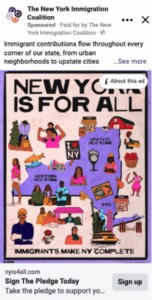
    Graphic example of a Meta ad for the New York for All campaign

    In contrast, with our NYIC work, “New York Is For All” messages focused on the safety value were highly effective across all audiences. For New Yorkers, messaging around safety beat out family, legacy, and worker frames. New Yorkers deeply resonate with the reality that ICE attacks make our communities less safe, make immigrant community members less likely to report crime, and undermine everyone’s safety.
    Both campaigns resonated with centrist and moderate audiences because their messaging was values-rich and values-specific, and brought new folks towards our side of the conversation.

    Integrate influencers

    Engaging influencers works best when you are strategic about audience targeting. Influencers don’t influence everyone, they influence particular audiences with particular interests. So using audience segmentation as a key factor in selecting influencers to work with ensures a lot more result for your ad dollar.

    For example, working to reach outside their current base, NILC experimented with connecting with influencers outside the social issue space. With our help, they built audiences based on each influencer’s audience’s interests (e.g. comedy, lifestyle, family). Their influencer strategy saw strong results with a reach of over 3 million and 145,000 post reactions, comments, shares, and saves.

    In New York City, our partners at NYIC worked with 3 different influencers to broaden and deepen the conversation on immigration justice. This led to a variety of highly resonant, down-to-earth content pieces that gave a human touch to the campaign. One was a simple selfie video on a walk, another was a heartfelt slideshow of their immigrant grandparents raising families and opening businesses in the 50s, and the last was a collection of casual street interviews of doormen across NYC and their raw outlooks on how immigrants positively impact their communities.

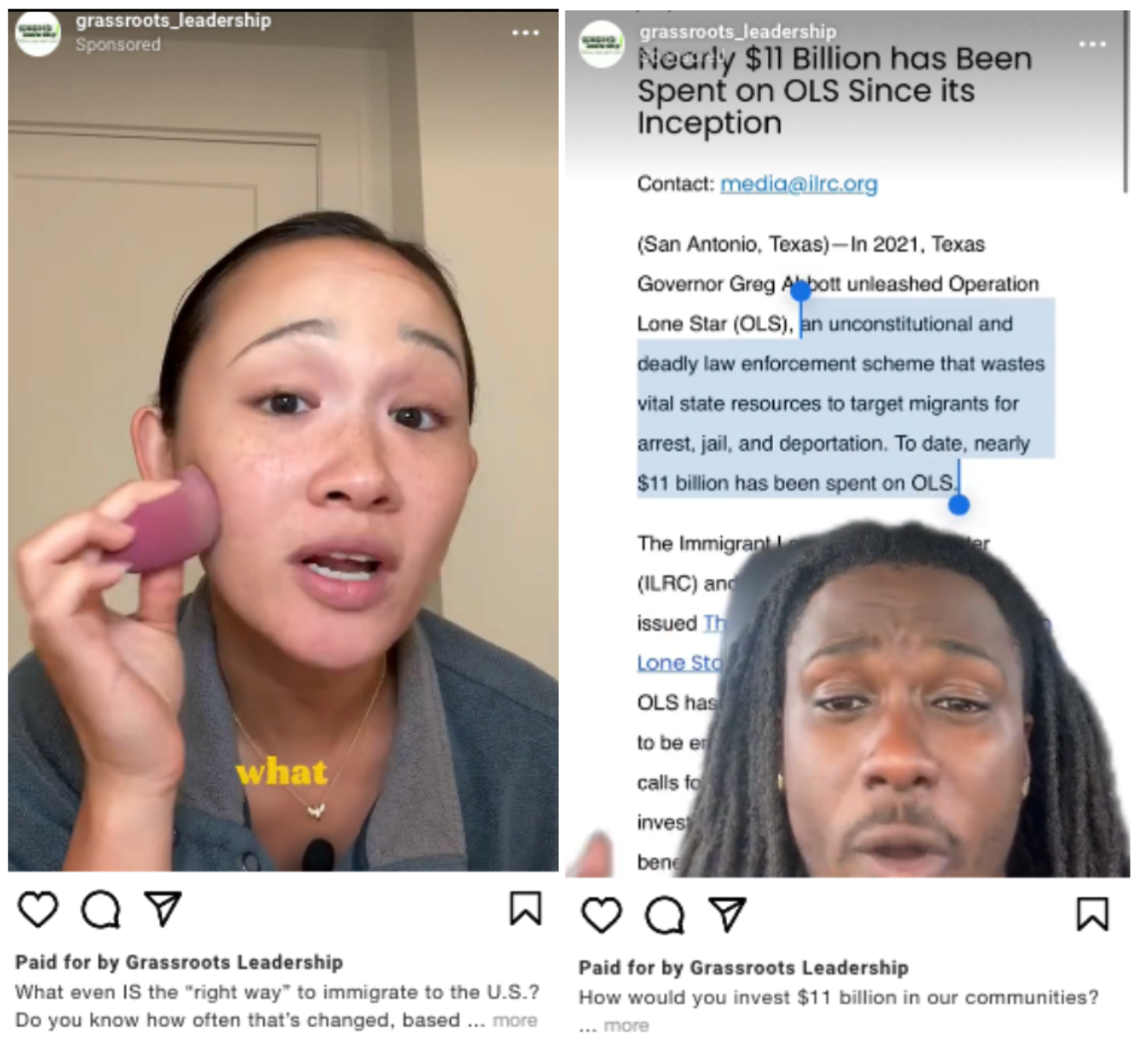
    In Texas, the Texans United for Justice (TUFJ) coalition, with the help of coalition partner Grassroots Leadership, worked with two influencers to educate the public on the true cost of rampant immigration enforcement.

    Screenshots of two social media influencer videos.
    Get ready with me style video (left) and selfie video debunking misinformation (right)

    Both influencer videos performed 65-70% better than what is typical for video views. The first piece was with the former Miss Texas where she explains the inequities in the immigration process while doing a “get ready with me” video, a popular style that instantly builds trust and connection due to the informal and casual setting. The second was a selfie video talking through media pieces, debunking misinformation, and providing facts on the true cost of unchecked immigration enforcement.

    Related Insights

    Meeting the moment
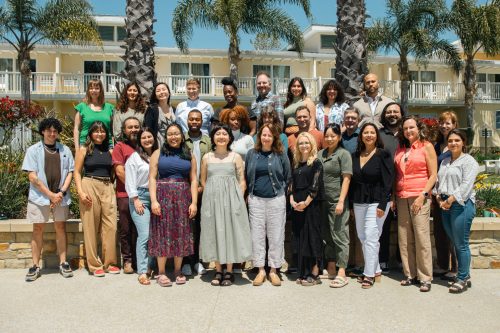
    Resource Media staff photo, featuring 30 people in two rows

    Meeting the moment

    Resource Media shares strategic communications guidance for progressive nonprofits to stay focused, frame issues effectively, and navigate misinformation in politically hostile times.

    Feb 13, 2025

    Read more
    How framing can cue — or avert — a partisan divide
    A wide view of a coal-fired power plant with multiple tall smokestacks emitting white smoke into a clear blue sky. The plant is surrounded by open fields, a water reservoir, and industrial structures, emphasizing the industrial and environmental impact of coal energy production.

    How framing can cue — or avert — a partisan divide

    Resource Media explores how framing energy issues around household costs rather than politics can bridge partisan divides, helping communities find common ground on coal and clean energy.

    Jan 16, 2025

    Read more