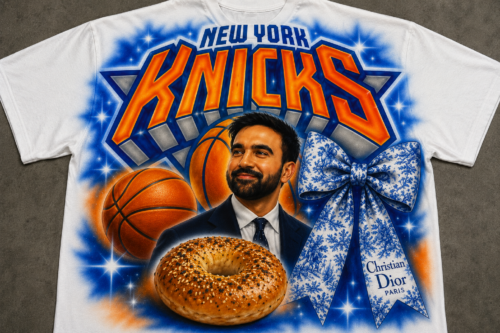
My mayor Muslim, My bagels Jewish, My Christian Dior, Knicks in 4!
In a unifying rallying cry that rocked around social media, one enthusiastic Knicks fan, MD Ahnaf Hussain, has done what eludes so many social justice movements: capture the joy of living in a city that lives and breathes immigration, diversity, and victory. A key element of this act is what this cry is replacing.
Thanks to the current administration and subsequent responses to it, we are pushed to conversations and narratives that depict immigrants as either a) criminals or b) charity cases. What’s missing from these depictions are the real and authentic experiences of immigrants and their families on an everyday basis, and importantly, the aspiration of living and coexisting in a multiracial democracy.
This Knicks fan, in his exuberant joy and hometown pride, celebrated the unprecedented rise of Mayor Mamdani, the contributions of Jewish immigrants, a twist on rap lyrics and ostentatious luxury, and of course support for the home team and its long-suffering fanbase. The chant has evolved and inspired endless riffs and spinoffs, further underscoring its catchiness – fans are now creating rhymes with “Knicks in Five” as the finals series evolves.
What makes this moment worth elevating is its contribution to a larger narrative about the value and joy of living in a diverse community. New York City is the pinnacle of an economic powerhouse that welcomes immigrants. Contrary to the narrative promoted by the right wing, New York City leapfrogs the notion that “immigrants do no harm” and launches us into the narrative that immigrants are essential for a thriving society, and it shows us not just with words or talking points but with evidence. The success of New York goes beyond economic figures, culture, and brand, but drives into sports – the ultimate playing field for objective winners and losers, with scores, refs, and rules that no one can chalk up to spin.
New York City is the place that welcomed my own grandparents, parents, aunts, and uncles. What personally attracted them were not necessarily stances held by politicians – it was other immigrants who formed the worker and customer base that they needed. This allowed them to take the leap and build businesses all over New York and Jersey, employing hundreds of other immigrants, and having passionate discussions about the Knicks in Cantonese over celebratory meals of Peking duck for over 40 years. The Knicks chant resonates because of whom it speaks to – the people – and also whom it does not: the system, which frankly hasn’t been serving us very well.
When I work with clients on narrative analysis and building, I often note that narrative can change very slowly or all at once. But because narrative change occurs on a much larger level, it can cut through to important audiences that may be out of reach for your organization. Sometimes that’s because you just don’t have the network yet, and let’s face it – powerful audiences like funders, elected officials, and bureaucrats do close themselves off from listening to the stories and experiences of advocates, organizers, and members of the public who have important perspectives to share. Narrative shifts have an ability to cut through these layers of distance so that a new (or renewed) reality is inevitable.
Narratives are also made up of many stories, each useful in their own way. I like to think of the myriad stories that make up a narrative like a garment. Like stories, each piece of cloth is cut and stitched together to form a garment that is designed to fit, and walk around in the world, exposing people to its style, function and personality.
The Knicks chant created a shiny, new, and useful story to add to the garment we’ve stitched together, weaving in the everyday stories of immigrants to reclaim a narrative on American diversity. Though somewhat threadbare, this narrative represents how Americans view ourselves: as welcoming to all, a land of possibility and creativity, and ultimately that we are stronger when there are more types of us who can celebrate wins together.