Prices keep climbing, work doesn’t pay as well as it should, and communities struggle to stay connected. What’s the common thread that would support change-makers working to build a fair and sustainable economy? What are the deep values that enliven our work to push back against inequality and build the networks of support we all need?
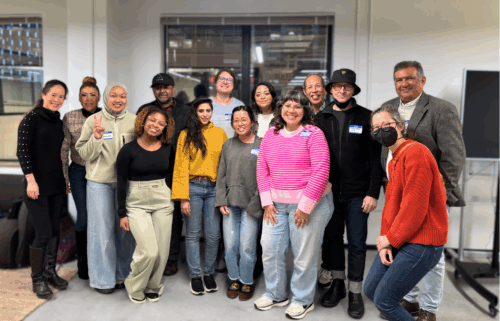
Together with an amazing group of 10 local King County economic justice leaders, we set out to develop a new shared narrative for a more equitable economic future. The Powerful Narratives Work Fellowship, built with the great folks at COO/King County Public Health, stitched core values and inspiring stories from across the greater Seattle area into a new narrative framework that’s available and useful to all.
The Common Thread Narrative is based on the deep knowing that:
- We are all connected, and our connections strengthen families, communities, businesses, and government.
- Like tree roots in the forest or a woven basket, support spreads through how we work, play, build businesses, and plan for the future, making all of us stronger.
- Our ability to survive depends on the strength of our shared community. That community is made up of threads that tie us together–good infrastructure, good schools, a clean environment and affordable healthcare.
- Beyond systems and policies, it’s about friendships, taking care of our families, our elders and our kids, and a feeling of dignity with work.
- But the ties that bind us together are being eroded. When we tend to them, and to each other, we all thrive.
We all do better when we all do better: Common Thread stories
Narratives are made up of interconnected stories, and each of these stories can, and should, look different and have a different function in the work of building a better world. This can mean shifting or reframing regressive narratives in order to build power, build narrative power to advance or stop a policy, or reprioritize around community vs. powerful interests.
These stories express the Common Thread narrative, and are useful to reach different folks with the truth of the common thread
Skilled labor: A construction worker who spotted bent columns in a building works quickly to evacuate the building, saving the lives of its occupants. He credited what he learned in a union apprenticeship and his skilled labor training.
Sharing is caring: Brian is an amateur woodworker who volunteers at his local tool-lending library, where he meets people in his community and solves unique problems using cool tools. Having a tool library means community members don’t need to take on unnecessary expenses themselves; instead they share resources and can access a broader range of tools to new things.
Baking together: Vince runs Anh Ơi, a Vietnamese American bake shop in Seattle’s Chinatown International District, and shares his shelves with other bakers. At the shop’s soft opening, customers bought goods from other bakers, which was the whole point. This new model brings bakers and customers together to a shared community table rather than relying on a single brand and competition.
Affordable apartments: When he notices the Arches Apartments across the street were up for sale, Brighton Communities’ Executive Director Curtis Brown doesn’t wait for the city to take action. As part of a deal he secures to purchase Arches Apartments, the building is protected as affordable for at least 99 years, with rent increases capped and, for some units, rents lowered. Brown’s insight from this process is that owning a piece of your neighborhood is the only way to guarantee you don’t get displaced from it. (Credit: People’s Economy Lab)
Opening doors: Sindy’s son Josue is a joyful toddler in our Early Learning Playgroup. She was nervous when a therapist first raised the possibility of an autism diagnosis, as she didn’t know what it would mean for her son’s future. Through Open Doors for Multicultural Families, she found not just services to help her through her son’s diagnosis, but also, a community that welcomed her. Now, when Sindy sees another parent struggling in public with a child like Josue, she carries a toy car or bubbles with her so she can step in and let that parent know they’re not alone. (Credit: Open Doors for Multicultural Families)
Solidarity with domestic workers: During the 2026 legislative session, young organizers across different communities in Washington united to advocate for the Domestic Workers Bill of Rights, which extends standard labor protections like minimum wage, written contracts, and meal breaks to the state’s domestic workers. Many of these young people organized by Washington Bus were the children of domestic workers, and others were not;instead, they showed up in solidarity with the youth advocating for their parents and communities. The bill became law, and young people were present at the bill signing to celebrate. (Credit: Washington Bus)
The Common Thread narrative spotlights stories that show how these connections benefit us – sometimes in intangible ways. These stories also show where we’re seeing some wear and tear; in other words, they show what needs to be repaired to restore the healthy interdependence that sustains a tightly-woven community.
Listen In
As part of the PNW Fellowship’s distribution strategy, fellows were interviewed by City Cast Seattle, who served as content partners with Communities of Opportunity. Through a series of paired interviews on a specific topic, each of the fellows learned how to move from talking points to stories that fit within a narrative. Watch and listen to their stories in the podcast series Weaving Our Future.
Join us
If you are interested in supporting or joining the Powerful Narratives Work fellowship as it continues into its third year, or you want to contact Resource Media about pursuing a narrative campaign, reach out to Sian Wu (she/her), managing director at Resource Media [email protected] or Belinda Griswold (she/her), senior program director at Resource Media: [email protected].